One of the things I've learned over more than forty years of researching my family is that not every ancestor leaves behind a wonderful collection of photographs, letters, or stories passed down through the generations. Some leave very little at all. A name on a census, a marriage announcement tucked into an old newspaper, a death certificate, or perhaps a gravestone.
And sometimes, if you're lucky, those little pieces begin to fit together.
When I started looking into my great-grandparents, James Thomas Horan and Mae Helen Wallace, I didn't know much about either of them. I knew they were the parents of my grandfather, James Wallace Horan, the man who had walked away from my father's life when Dad was only three years old. But I knew almost nothing about the family that had come before him.
As it turns out, there was quite a bit waiting between the lines.
Eleven Children and a Houseful of Horans
James Thomas Horan was born in St. Louis, Missouri, in 1875, the son of Thomas Horan and Elizabeth Byrne, both born in Ireland. And Thomas and Elizabeth apparently weren't afraid of a crowded house.
So far, I've identified at least eleven children in their family, born between 1875 and 1893. There was James Thomas, followed by Mary E., Michael L., Thomas Matthew, Martin Joseph, John Parnell, Alphonses, Flore Olivia, Francis, Susan, and Elizabeth Theresa. Eleven children. I can barely imagine the noise around the dinner table, much less the laundry.
I wonder what kind of household they grew up in. Did Thomas and Elizabeth tell stories about Ireland? Did they talk about the family they'd left behind? Were there stories about kings and ancient ancestors, perhaps even the sort of tales Dad loved to tell about our supposed connection to Brian Boru? I'd love to know. Unfortunately, the census doesn't have a column for family legends.
What it does tell me is that some of the Horan siblings remained connected well into adulthood. In 1930, a household at 1469 Shawmut Place in St. Louis included Thomas Horan, Laura Susan Horan, and their widowed sister Elizabeth Horan Taylor. The reported ages don't line up neatly with all the earlier records, so there are still details to untangle, but the address itself became another thread to follow. Laura Susan was still associated with Shawmut Place decades later, including at the time of her death in 1960.
It's a small glimpse into the lives of siblings who had grown old together, or at least remained part of one another's lives, long after the crowded childhood home was gone.
James and Mae
In 1905, James Thomas Horan and Mae Helen Wallace appeared together in a St. Louis newspaper's marriage license notices. James was listed at 3835 Easton Avenue, and Mae at 1311 Temple Place. I love finding little details like that. Two street addresses, printed side by side more than a century ago, marking the beginning of a family I would eventually belong to. Of course, the notice doesn't tell me how they met, what they thought of each other, or what their wedding day was like. It doesn't even establish the exact date they married. But it places them together at a particular moment in time, and sometimes that's where a story begins.
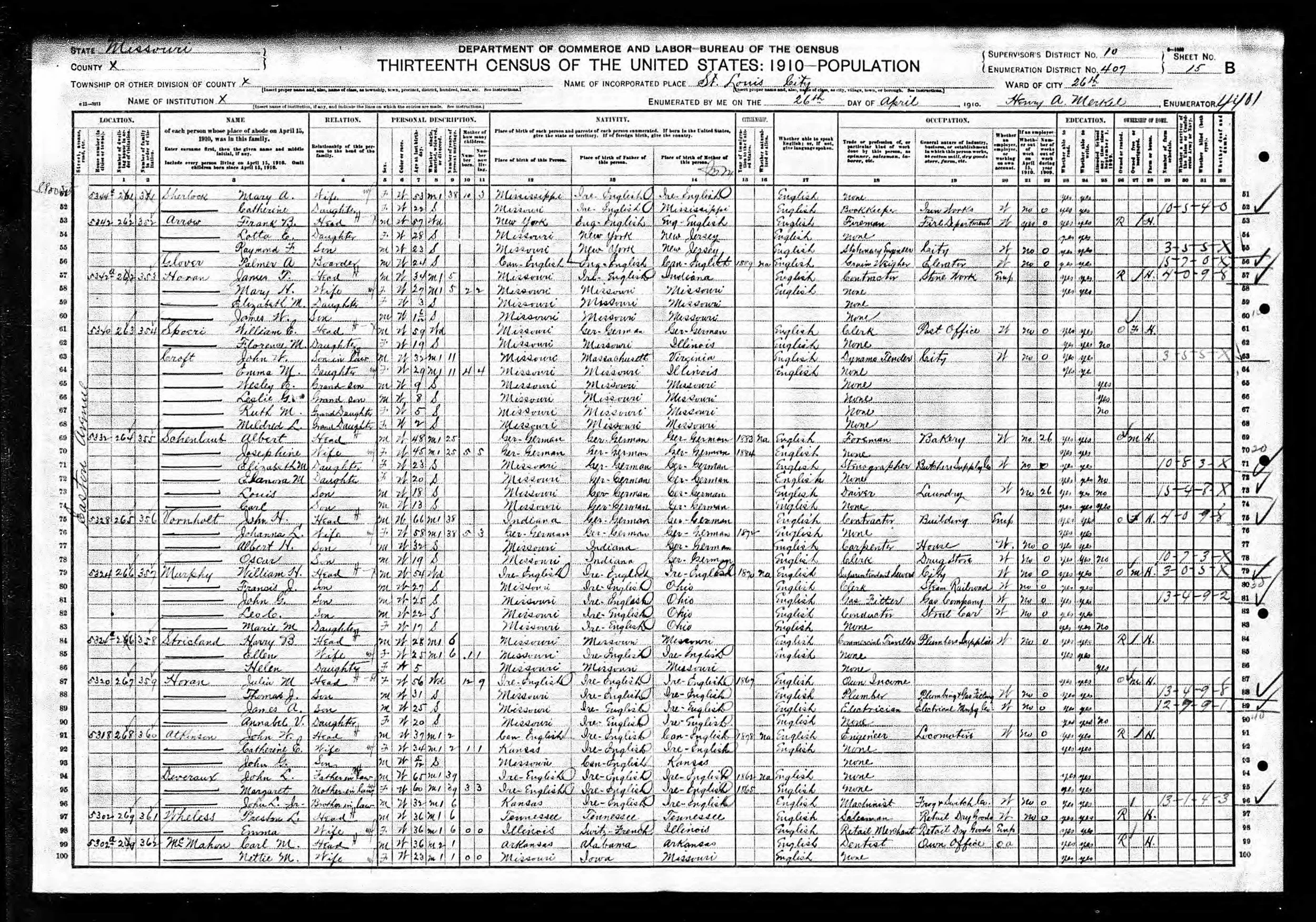
By 1910, James and Mae had two children living at home. Their daughter Elizabeth was three years old, and their son James W. was listed as one year and six months old. Mae also reported that she'd given birth to two children and that both were living.
That might seem straightforward, except genealogy rarely seems willing to let me have anything quite that easy.
I also found a St. Louis birth registry entry from September 1908 for a boy named William W. Horan, born to James T. Horan and May Wallace. At first, I thought I'd discovered another child. Then I looked again at the 1910 census. James W.'s recorded age places his birth around the autumn of 1908, remarkably close to the birth registry entry for William. The parents' names match, and the census accounts for two children, Elizabeth and James.
So now I'm wondering whether William W. Horan and my grandfather, James Wallace Horan, were actually the same person. Was William the name originally recorded at his birth? Did his parents later decide to call him James? Was one of the records simply wrong? I don't know. And until I find something that connects the two names more conclusively, it remains a theory rather than a fact.
But I have to admit, after spending decades trying to unravel the mystery of my grandfather, the possibility that even his original name might be different from the one I've always known is rather fitting.
The Little Girl Who Disappeared
There was another discovery in that 1910 census, one that turned out to be much sadder. Elizabeth Horan was three years old when the census taker recorded her name. She was the older sister of my grandfather, a little girl living with her parents and younger brother in St. Louis. But when I found the family in the 1920 census, Elizabeth wasn't there.
At first, I didn't know why. People disappear from census records for all sorts of reasons. They move, live with relatives, or turn up under a name you weren't expecting. So I kept looking. Eventually, I learned that Elizabeth had died when she was just twelve years old. Twelve years old. An entire life reduced, at first glance, to a single childhood census entry and a burial record.
Elizabeth is buried in the same family plot as her mother, Mae Helen Wallace Horan, and her maternal grandfather, William H. Wallace. Three generations of the same family, connected not only through the records of their lives but also through the place where they were laid to rest.
I don't know what Elizabeth looked like or what made her laugh. I don't know whether she was the protective sort of older sister or the kind who found her little brother endlessly irritating. Having grown up around siblings myself, I suspect there may have been a little of both. I don't yet know the circumstances of her death, either. But I do know she was here. She was someone's daughter, someone's granddaughter, and my grandfather's older sister. And she was loved by people whose lives continued after hers ended.
I started this research trying to understand the grandfather my father never really knew. I hadn't expected to find a little girl whose name had almost disappeared from our family story. Now that I've found her, I don't intend to lose her again.
A Life Recorded in Columns
By 1930, James Thomas and Mae were living in Richmond Heights, in St. Louis County, with their son James Wallace. The census listed James Thomas as a janitor in a building. His death certificate, recorded only two years later, identified his occupation as a real estate broker. Was he working in real estate by the end of his life? Had he held several different jobs? Did one record simply reflect a different understanding of his work? I can't say.
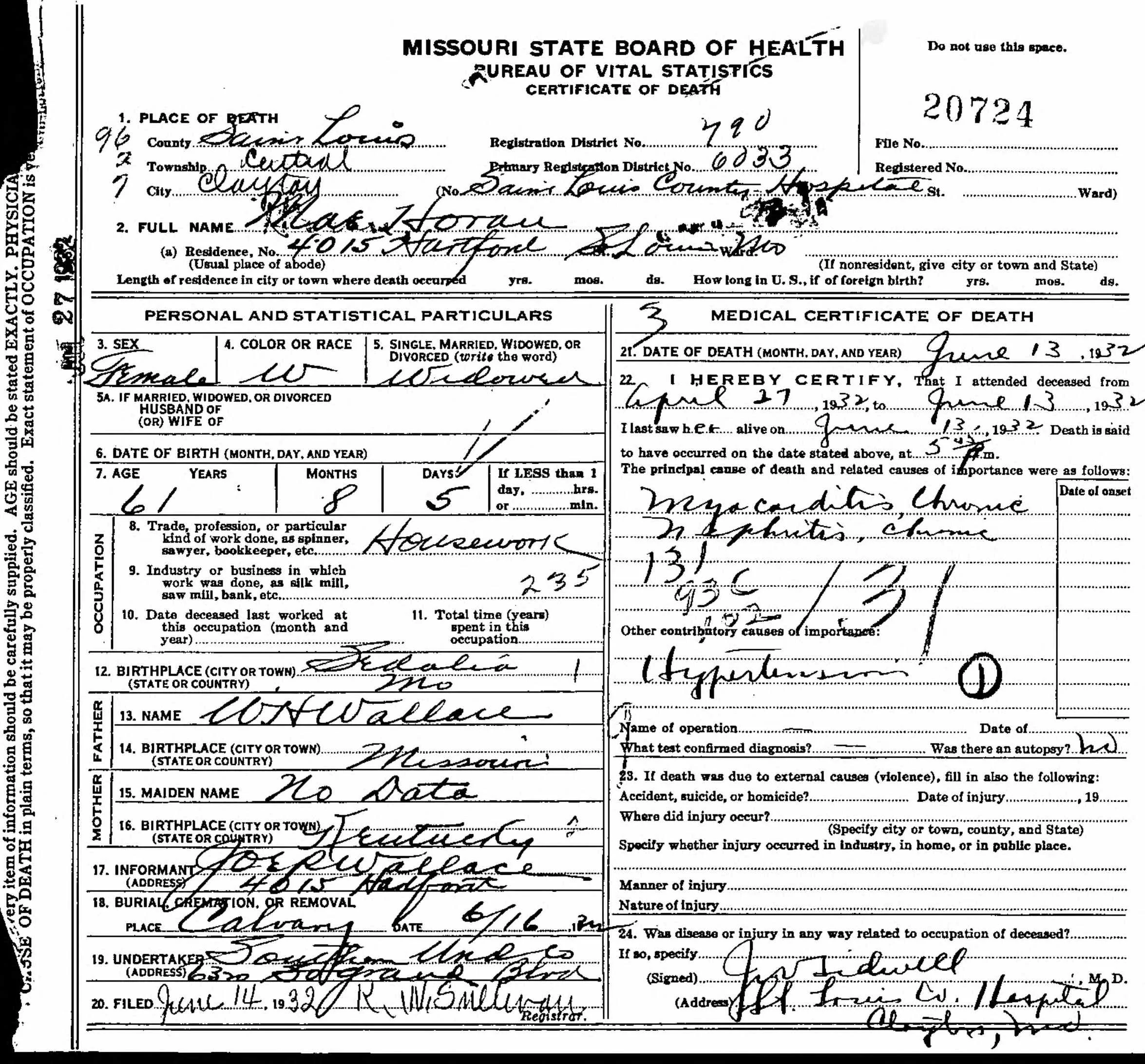
Mae's occupation on her death certificate was listed as housework, one of those little phrases that manages to describe an enormous amount of labor while telling us almost nothing about the woman doing it.
I wonder about Mae quite a bit. What was she like? Was she funny? Serious? Patient? Did she have a temper? Did she enjoy a quiet afternoon, or was she the sort of woman who always needed something to do? And what was life like for her after losing Elizabeth?
There are no columns on the census for grief, resilience, or the thousands of ordinary moments that make up a marriage and a family. Those are the things I wish I could ask her.
Sixty-Eight Days
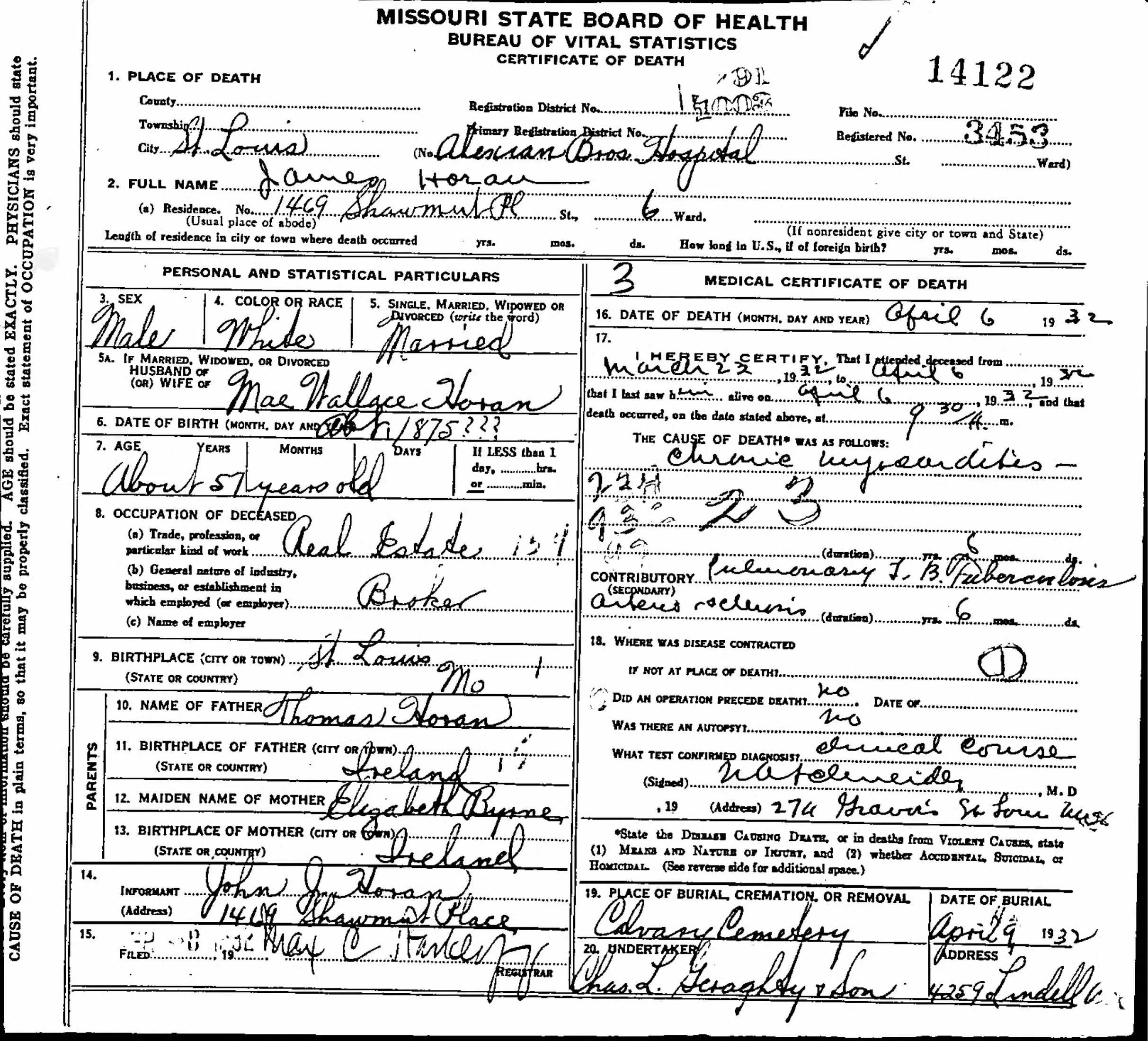
On April 6, 1932, James Thomas Horan died at Alexian Brothers Hospital in St. Louis. He was approximately fifty-seven years old. His death certificate recorded chronic myocarditis, with pulmonary tuberculosis and arteriosclerosis listed as contributing conditions. It also identified his parents as Thomas Horan and Elizabeth Byrne, both born in Ireland, giving me another important link to the generation before him. The informant was a John J. Horan, someone whose precise place in the family I haven't yet established. With so many Horans in St. Louis, I don't want to assume a relationship simply because the surname matches. James Thomas was buried at Calvary Cemetery.
Just sixty-eight days later, on June 13, 1932, Mae died.
She was sixty-one years old. Her death certificate listed chronic myocarditis and chronic nephritis, with hypertension as a contributing condition. I don't know whether losing her husband affected Mae's final weeks, and the medical records don't establish a connection between their deaths. Still, I can't help thinking about what those sixty-eight days must have been like for the family.
They had already lost Elizabeth. Now, in the space of a little more than two months, both parents were gone.
Their son James Wallace was a young adult by then, and whatever happened afterward, this was part of the family history he carried with him.
My father knew nothing about any of it. Dad had been only three years old when James Wallace left his family in Chicago. He never saw his father again. The stories of the people who came before James Wallace never reached him at all. And yet here I am, generations later, trying to piece them back together.
The People Behind the Names
When I first began researching the Horan family, I was looking for answers about one man: the grandfather who disappeared from my father's life. But family history has a way of taking you somewhere you weren't expecting.
A marriage license led me to James and Mae. A birth registry raised questions about my grandfather's name and birth year. A census introduced me to Elizabeth, and another census made me wonder where she'd gone. A burial record finally gave me an answer I wasn't particularly happy to find.
Along the way, I discovered an enormous Irish-American family, siblings who remained connected through the years, and a husband and wife whose lives ended just sixty-eight days apart.
I still have plenty of unanswered questions. Some may eventually be solved with another record, another newspaper clipping, or another late-night search when I really should have gone to bed hours earlier.
Others may remain mysteries.
But I think that's part of what keeps me doing this. Every time I find another name, I remember that it belonged to a real person who had an entire life outside the few details that survived on paper.
And if I can bring even a little of that life back into the family story, then all those years of searching have been worth it.
I think Dad would have liked that.